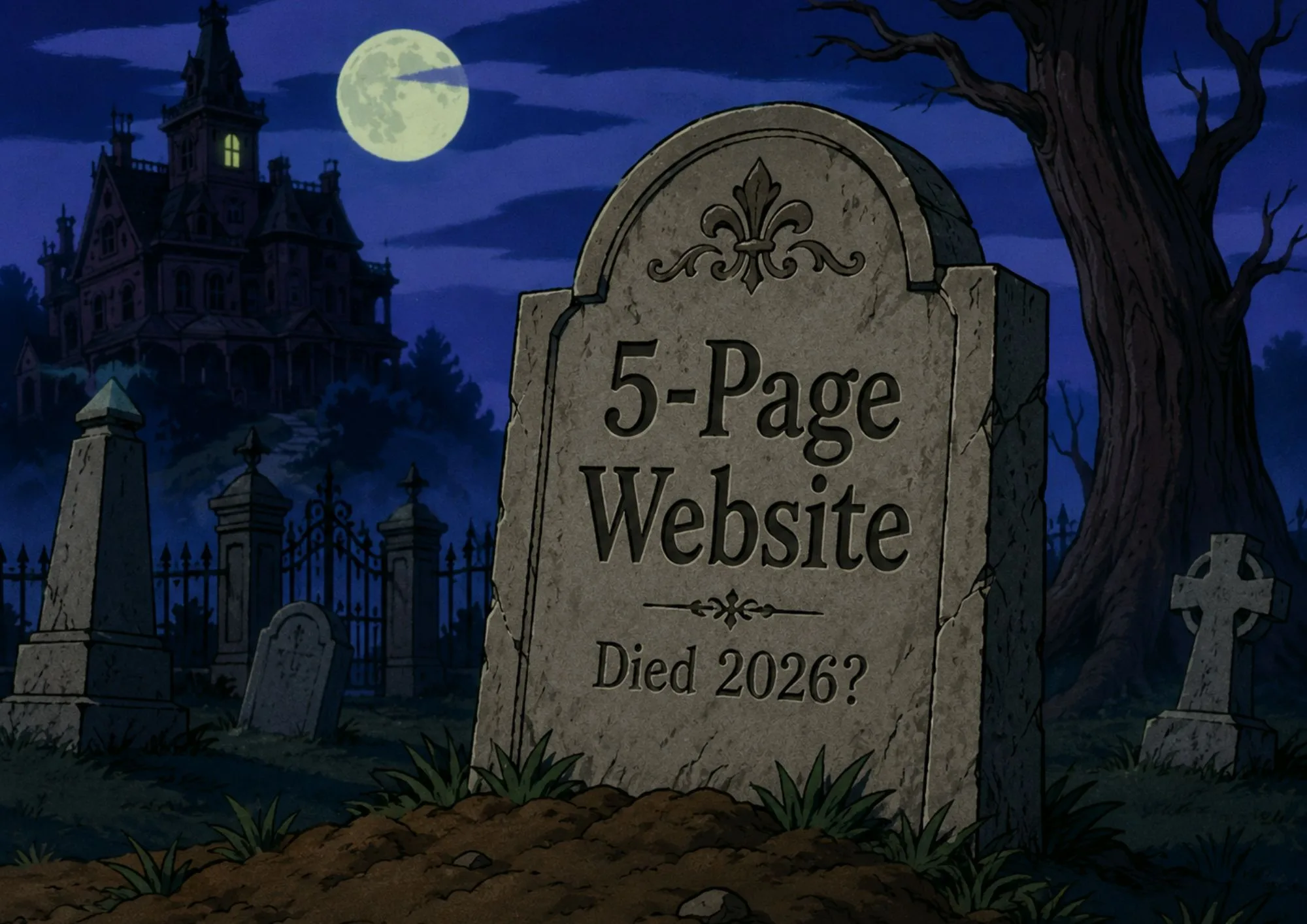
The Death of the Five-Page Website?
Modern websites are being redesigned around decisions, not navigation.
For years, the standard small business website followed a familiar formula.
Homepage. Services. About. Contact.
Later, many businesses added a blog in the hope of improving their visibility online. The result became the now-familiar “five-page website” structure that shaped much of the modern web.
There's nothing inherently wrong with that structure. It made perfect sense for the internet of the early 2000s and even much of the 2010s. The problem is that, while user behaviour has changed dramatically, many websites haven't evolved to meet the behaviour.
Today, there's increasing discussion around the “death of the five-page website.” Some of those conversations are useful. Others are trend-driven noise. The reality, as always, is more nuanced. The issue isn't that websites should suddenly have fewer pages, nor that every business should replace its website with a single scrolling landing page. The real issue is that many websites are still built around how businesses organise information rather than how people actually make decisions.
That distinction matters more now than ever.
Traditionally, websites were designed with the assumption that visitors would browse. A user might arrive on a homepage, explore the menu, click through multiple sections, compare information, and gradually build an understanding of the business. The website provided the information. The visitor was expected to assemble the experience themselves.
Modern users behave differently. People arrive with intent. They're usually trying to answer a small number of very specific questions: "Can this company solve my problem?", "Can I trust them?" and "What should I do next?"
If those answers aren't immediately clear, they leave. The rise of mobile browsing, shorter attention spans, and increased competition has only amplified this behaviour.
This is where many traditional websites begin to fail. Even visually impressive sites can struggle commercially because they remain passive. They present information but do little to guide decisions. They rely on visitors to browse, interpret, compare, and piece together a pathway themselves. Most users simply won't invest that level of effort.
The best-performing websites today are increasingly designed around pathways rather than pages. This is a subtle but important shift in thinking. A page-based website focuses on structure and navigation. A pathway-based website focuses on intent and progression. Instead of simply listing services, the website actively guides the visitor towards the information, reassurance, and actions most relevant to their situation.
That might sound like a small difference. Commercially it's significant.
Consider the difference between a generic Services page and a more intentional user pathway. A traditional Services page often attempts to explain everything a business does in one place. A pathway-based approach instead acknowledges that different visitors arrive with different problems, levels of understanding, and motivations. One visitor may be looking for credibility and reassurance. Another may already be comparing suppliers. A third may simply want to understand pricing or timelines. A website built around pathways recognises these different states and responds accordingly.
This shift is also being accelerated by the rise of AI-driven search and discovery tools such as ChatGPT and Perplexity AI. Users are no longer relying solely on traditional search engines and broad exploratory browsing to discover information. Increasingly, they arrive at websites after already conducting significant research elsewhere. AI tools are compressing the discovery process, helping people refine their questions, compare options, and clarify their needs much earlier in the journey.
As a result, the role of the website itself is beginning to change. In many cases, websites are becoming less about discovery and more about validation and decision-making. By the time someone lands on a business website, they're often much closer to making a decision than they would have been five years ago. That means clarity, structure, and guided progression become critically important.
This broader shift has also contributed to the rise of long-form, single-page websites. Many businesses have recognised that reducing friction and guiding users through a more linear experience can improve engagement and conversion. However, the popularity of single-page websites is often misunderstood. The underlying principle isn't that fewer pages are inherently better. Rather, businesses are attempting to create a clearer and more focused pathway for visitors.
For businesses with simple offers and a single clear action, that approach can work extremely well. However, more complex businesses often require multiple pathways rather than a single linear journey. A company offering several services, targeting different customer groups, or supporting longer decision-making cycles still requires structure and depth. The solution isn't necessarily fewer pages. It's more intentional architecture.
This is why the conversation around modern web design should move beyond aesthetics alone. Many businesses redesign the appearance of their website while leaving the underlying experience untouched. They improve colours, typography, animations, or imagery, but retain the same passive structure beneath the surface. As a result, very little changes commercially. The website may look newer, but it still relies on users to navigate and interpret the experience for themselves.
The businesses that are succeeding online are increasingly those who understand that websites are no longer static brochures. They are operational tools. They shape customer perception, influence decision-making, support sales activity, and increasingly integrate with broader business systems and processes. A modern website should evolve alongside the business it represents.
Ultimately, the “death of the five-page website” isn't really about page count at all. It's about a broader change in how users behave online and how businesses respond to that behaviour. Pages still matter. Navigation still matters. Structure still matters. But the websites that perform best today are those that focus less on simply presenting information and more on guiding people toward outcomes.
People do not visit websites to admire navigation menus. They visit because they are trying to solve problems, reduce uncertainty, and make decisions. The businesses that recognise that shift - and design accordingly - will be the ones that stand out over the next decade.